'Neither rousing marches, lively reels, nor melancholy laments seemed to have any effect on these lethargic, phlegmatic birds; there was no excitement, no sign of appreciation or disapproval, only sleepy indifference.'Reports of the penguin's reaction.
Tuesday, 10 December 2013
A penguin and a bagpiper
Readers of this blog might recall that I have a bit of a soft-spot for penguins (here too). And for Antarctica, and unusual photos in that snowy wilderness. Bagpipes, well... In any case, here's a fantastic picture of a penguin and a bagpiper in Antarctica. Really. I love the way the penguin is standing to attention. This picture was, I believe, taken in 1902 or 1903 during William Speirs Bruce's expedition. As a bit of a sideline, the ship's bagpiper (this story sounds less and less likely as I write it) decided to see how the penguin reacted to different sorts of traditional music. Apparently, he was indifferent. As for the bagpiper, I hope there's some warm underwear under that kilt.
Friday, 29 November 2013
Bach from Murray Perahia
There's no one quite like Bach. Every time I hear the Aria from his Goldberg Variations – a keyboard masterpiece written, so the story goes, to soothe an insomniac Russian ambassador – I feel myself pause and forget whatever I've been doing. It's music of the most beautiful serenity. Here it is performed by the superlative Murray Perahia.
Sunday, 10 November 2013
The Summit
We start to walk at midnight. It's cold but, for once in my life, I don't feel it. Probably because I am wearing two pairs of thermals, trousers, waterproof trousers, inner socks, outer socks, a thermal vest, a long-sleeved thermal top, a fleece, a fleece gilet, two pairs of gloves, walking boots, a down jacket, a fleece scarf and a hat. And my big rucksack and a head torch. In the bag I have put another large fleece. I'm not taking any chances. My camera battery is in an inside pocket to keep it cosy, and my water bottle and camelbak – a sort of pouch with drinking tube – are wrapped up tight to stop them freezing. We've all been instructed to blow into the camelbak's tube after drinking in order to push all the water back inside, or at your next drink you'll be greeted with ice.
It's the day before the full moon. It's almost as if it's watching over us, choosing to light our way. We almost don't need the torches as we start our long trudge to the top. The aim is to reach Gilman's Point, at the edge of the crater, for sunrise. If you imagine taking one step, counting to three, then taking another, that's about the pace we went at. We were only going gently uphill – the crater sides are offputtingly steep but we're zig-zagging – yet we're all out of breath, huffing and puffing as if we were running a marathon. I can make out another group ahead of us, slowly moving dots of light. There's a small frisson of gloating as we overtake them. But at our first break, it's clear some people are already feeling the strain. I munch a couple of the sugary biscuits I've been given as a snack, while others eat their Dairy Milk chocolate. It gives them energy but seems to make everyone feel ill; for once I'm glad that I have to have the non-dairy option. It's too cold to loiter, so we're soon on the move again.
The guides start to sing. A solo voice sings a line, the rest respond. It's unexpected, magical and completely surreal. Am I really here, climbing up this mountain in the early hours of the morning, with the moon and music?
The combination of painful effort and nausea remind me that, yes, indeed, I am really here. Someone tells us a story about one of his friends who is an ultramarathon runner. When you run a regular marathon, he says, you start to question why you're doing it, why you're pushing yourself through such gruelling pain. In an ideal world, you come through that stage on a new high, full of positive energy ad belief that you are on the right path. When you run an ultramarathon, the questioning is commensurately more profound: you start to question your existence, what you're doing with your life, are you in the right job, the right relationship, doing the right thing? I reckon you can see it as raw honesty with yourself or self-torture. Either way, it's an exposed place to be. And it's not somewhere I really want to go, psychologically speaking, while I'm on this mountain.
As we plod closer to the top, though, it gets harder and harder to convince myself to keep going. I try to stop my thoughts. Huh. Harder than you think. I resort to counting from one to a hundred, over and over. It's dull, but it does the trick. I can see lights above us: are they path-markers, trekkers or stars?
The ground underneath has been dusty most of the way up but towards the upper reaches of the path it becomes stony and rocky. Our guide points towards the top, saying it's not far now, but it's so hard to tell whether there's more rock behind what we can see that I decide not to look or trust him and just keep on trudging. The rocks become bigger and bigger, and we have to scramble and climb. For some reason, it feels less difficult than it should do. Then I realise that I'm being given a helping push by one of the guys in the group. (Thank you!) As we near the top, our guide tells us it's just ten minutes away. None of us believe him and someone decides to have a bet with him. I've gone into a sort of semi-comatose state now. One of the Aussies chooses this moment to reveal he's actually scared of heights... It actually does feel pretty high up when I look - the jagged peaks of Mawenzi which have been towering over us the past days are now below us – and I start to wonder how we'll get back down.
And then we're at Gilman's Point. 5,681 metres up. We came round some rocks to find not, as before, more of a climb, but instead the flat edge of the crater rim and a big green sign congratulating us. We pose in front of it, taking photos. I'm frozen and exhausted. I feel like I should eat for energy but I don' have the appetite. All twelve of us have made it to Gilman's. The sun has risen, nature's great metaphor. We barely have any time before one of the guides is shepherding us on to get round to Uhuru, the highest point of Kilimanjaro. Now or never. At first, I think I can't do it. Sitting here now, writing this, I'm shouting at myself. You were going to go back down? After all that effort! Just keep going!
Four or five people have gone ahead, and I rush after them - deciding to give it a go. But the pace is fast, and after a few minutes I just feel so tired. I sit down and say I'm going to go back. Another woman in the group comes back, asks if I'm sick - I'm not – and says, forcefully: 'I'm not going to be the only woman in this group to make it to the top. You're coming with us'. That was possibly the best thing she could have said. (And thank you too!) One of the brilliant guides runs back to ask what's wrong, and when I say I'm tired, he says that's no excuse, takes my backpack, asks why it's so heavy (the fleece!) and then we're on the move again.
As we make our way round the crater edge, we start to see a few people coming back down from the summit. One young woman is stumbling and being supported by a guide. Up here, there's only half the oxygen you need. It feels like being drunk and hung-over at the same time. We make several stops to look at the fantastic views and rest. The two tallest men in the group seem to be suffering the worst. One curls up by the side of the path and is sick. Another keeps on collapsing on his bag, saying, with no small hint of melodrama, 'go on without me'.
We keep on going. Past Stella Point, until the path to Uhuru Peak is finally in view, clear ahead of us. It's a race to the finish (though who made it to there first is still being disputed). We've made it to the top! It is a fantastic feeling: looking out from the top of Africa, the summit of the highest free-standing mountain in the world. We are at Uhuru, which, in Swahili, means 'freedom'. It's gloriously clear: blue skies, warm sun. Photo-perfect.
We join the queue to take photos in front of the sign. It's quite busy. Three Italians push in front of us, causing one member of our group to tell them in no uncertain terms that we've got 'ill people here' and we have to take our pictures now. The slight exaggeration works. We get our photos, alone, in groups, with the various charity flags and posters people have brought with them.
Ten minutes or so is all you get at the top, and then the long journey back down begins. I start ahead of the group, and, actually, it's just a wonderful feeling walking through this incredible, alien landscape, white snow glistening under the peachy sun. There's a magnificent glacier to one side, the intriguing bowl of the crater to the other.
It takes between an hour and an hour and a half to get back to Gilman's, where the descent begins. If going up the mountain seemed tough, then going down the mountain is tougher still. The dust is nearly a foot deep, and slippy. I start to carefully pick my way down the path, but it's clear I'm going too slowly. One of the guides grabs my arm and we start to 'ski', sliding and skidding in giant steps, throwing up clouds of dust. We chat as we go: he tells me about his wife and children, we compare the price of food in England and Africa, he tells me about how he used to be a teacher but then became a guide. One day, he says, he'd like to be a chief guide. I am sure he will.
Nearly three and a half hours after leaving the summit, I arrive back in camp. I feel elated. I did it!
Time for a rest. Into the tent: my feet hurt, and I feel like I have pins and needles in my brain. No joke. It's not a comfortable sleep. And a little over an hour later, we're up again to eat before we have to start trekking to our next camp. People are returning one by one, at their own pace. When we sit down for lunch (only lunch! It feels like we've packed a week's worth of experience into the past twelve hours) some of us are feeling the sense of achievement (We made it to the top!), others are suffering. One trekker needs oxygen after his asthma starts playing up thanks to the dust. Another refuses to talk about it, saying it's both the best thing she's done and the most miserable day of her life.
After lunch, we pack and are on the move again. There's no drinking water at Kibo, so we need to get to the next camp down for the night. And to make away for any other groups arriving to attempt the summit. It's a fourish-hour walk back across the Lunar Desert, this time peeling to the right down the Marangu route. It's actually good to stretch out tired limbs with a walk over flat ground. And when we reach the next camp down, the air is already a little richer and the mountain top already looks like a distant reality. Food, cards, gossip, sorting out of the tips for the guides and porters, and it's time for sleep. I've been to the summit of Kilimanjaro. And I can't stop smiling.
This is my fifth post about my trip-of-a-lifetime climbing Mount Kilimanjaro and going on safari in Tanzania. I'm raising money for Water Aid so if you would like to sponsor me, please click here. So far I've raised £780. Thank you so much to everyone who was given money. It is going to a great charity.
It's the day before the full moon. It's almost as if it's watching over us, choosing to light our way. We almost don't need the torches as we start our long trudge to the top. The aim is to reach Gilman's Point, at the edge of the crater, for sunrise. If you imagine taking one step, counting to three, then taking another, that's about the pace we went at. We were only going gently uphill – the crater sides are offputtingly steep but we're zig-zagging – yet we're all out of breath, huffing and puffing as if we were running a marathon. I can make out another group ahead of us, slowly moving dots of light. There's a small frisson of gloating as we overtake them. But at our first break, it's clear some people are already feeling the strain. I munch a couple of the sugary biscuits I've been given as a snack, while others eat their Dairy Milk chocolate. It gives them energy but seems to make everyone feel ill; for once I'm glad that I have to have the non-dairy option. It's too cold to loiter, so we're soon on the move again.
The guides start to sing. A solo voice sings a line, the rest respond. It's unexpected, magical and completely surreal. Am I really here, climbing up this mountain in the early hours of the morning, with the moon and music?
The combination of painful effort and nausea remind me that, yes, indeed, I am really here. Someone tells us a story about one of his friends who is an ultramarathon runner. When you run a regular marathon, he says, you start to question why you're doing it, why you're pushing yourself through such gruelling pain. In an ideal world, you come through that stage on a new high, full of positive energy ad belief that you are on the right path. When you run an ultramarathon, the questioning is commensurately more profound: you start to question your existence, what you're doing with your life, are you in the right job, the right relationship, doing the right thing? I reckon you can see it as raw honesty with yourself or self-torture. Either way, it's an exposed place to be. And it's not somewhere I really want to go, psychologically speaking, while I'm on this mountain.
As we plod closer to the top, though, it gets harder and harder to convince myself to keep going. I try to stop my thoughts. Huh. Harder than you think. I resort to counting from one to a hundred, over and over. It's dull, but it does the trick. I can see lights above us: are they path-markers, trekkers or stars?
The ground underneath has been dusty most of the way up but towards the upper reaches of the path it becomes stony and rocky. Our guide points towards the top, saying it's not far now, but it's so hard to tell whether there's more rock behind what we can see that I decide not to look or trust him and just keep on trudging. The rocks become bigger and bigger, and we have to scramble and climb. For some reason, it feels less difficult than it should do. Then I realise that I'm being given a helping push by one of the guys in the group. (Thank you!) As we near the top, our guide tells us it's just ten minutes away. None of us believe him and someone decides to have a bet with him. I've gone into a sort of semi-comatose state now. One of the Aussies chooses this moment to reveal he's actually scared of heights... It actually does feel pretty high up when I look - the jagged peaks of Mawenzi which have been towering over us the past days are now below us – and I start to wonder how we'll get back down.
And then we're at Gilman's Point. 5,681 metres up. We came round some rocks to find not, as before, more of a climb, but instead the flat edge of the crater rim and a big green sign congratulating us. We pose in front of it, taking photos. I'm frozen and exhausted. I feel like I should eat for energy but I don' have the appetite. All twelve of us have made it to Gilman's. The sun has risen, nature's great metaphor. We barely have any time before one of the guides is shepherding us on to get round to Uhuru, the highest point of Kilimanjaro. Now or never. At first, I think I can't do it. Sitting here now, writing this, I'm shouting at myself. You were going to go back down? After all that effort! Just keep going!
Four or five people have gone ahead, and I rush after them - deciding to give it a go. But the pace is fast, and after a few minutes I just feel so tired. I sit down and say I'm going to go back. Another woman in the group comes back, asks if I'm sick - I'm not – and says, forcefully: 'I'm not going to be the only woman in this group to make it to the top. You're coming with us'. That was possibly the best thing she could have said. (And thank you too!) One of the brilliant guides runs back to ask what's wrong, and when I say I'm tired, he says that's no excuse, takes my backpack, asks why it's so heavy (the fleece!) and then we're on the move again.
As we make our way round the crater edge, we start to see a few people coming back down from the summit. One young woman is stumbling and being supported by a guide. Up here, there's only half the oxygen you need. It feels like being drunk and hung-over at the same time. We make several stops to look at the fantastic views and rest. The two tallest men in the group seem to be suffering the worst. One curls up by the side of the path and is sick. Another keeps on collapsing on his bag, saying, with no small hint of melodrama, 'go on without me'.
We keep on going. Past Stella Point, until the path to Uhuru Peak is finally in view, clear ahead of us. It's a race to the finish (though who made it to there first is still being disputed). We've made it to the top! It is a fantastic feeling: looking out from the top of Africa, the summit of the highest free-standing mountain in the world. We are at Uhuru, which, in Swahili, means 'freedom'. It's gloriously clear: blue skies, warm sun. Photo-perfect.
We join the queue to take photos in front of the sign. It's quite busy. Three Italians push in front of us, causing one member of our group to tell them in no uncertain terms that we've got 'ill people here' and we have to take our pictures now. The slight exaggeration works. We get our photos, alone, in groups, with the various charity flags and posters people have brought with them.
Ten minutes or so is all you get at the top, and then the long journey back down begins. I start ahead of the group, and, actually, it's just a wonderful feeling walking through this incredible, alien landscape, white snow glistening under the peachy sun. There's a magnificent glacier to one side, the intriguing bowl of the crater to the other.
It takes between an hour and an hour and a half to get back to Gilman's, where the descent begins. If going up the mountain seemed tough, then going down the mountain is tougher still. The dust is nearly a foot deep, and slippy. I start to carefully pick my way down the path, but it's clear I'm going too slowly. One of the guides grabs my arm and we start to 'ski', sliding and skidding in giant steps, throwing up clouds of dust. We chat as we go: he tells me about his wife and children, we compare the price of food in England and Africa, he tells me about how he used to be a teacher but then became a guide. One day, he says, he'd like to be a chief guide. I am sure he will.
Nearly three and a half hours after leaving the summit, I arrive back in camp. I feel elated. I did it!
Time for a rest. Into the tent: my feet hurt, and I feel like I have pins and needles in my brain. No joke. It's not a comfortable sleep. And a little over an hour later, we're up again to eat before we have to start trekking to our next camp. People are returning one by one, at their own pace. When we sit down for lunch (only lunch! It feels like we've packed a week's worth of experience into the past twelve hours) some of us are feeling the sense of achievement (We made it to the top!), others are suffering. One trekker needs oxygen after his asthma starts playing up thanks to the dust. Another refuses to talk about it, saying it's both the best thing she's done and the most miserable day of her life.
After lunch, we pack and are on the move again. There's no drinking water at Kibo, so we need to get to the next camp down for the night. And to make away for any other groups arriving to attempt the summit. It's a fourish-hour walk back across the Lunar Desert, this time peeling to the right down the Marangu route. It's actually good to stretch out tired limbs with a walk over flat ground. And when we reach the next camp down, the air is already a little richer and the mountain top already looks like a distant reality. Food, cards, gossip, sorting out of the tips for the guides and porters, and it's time for sleep. I've been to the summit of Kilimanjaro. And I can't stop smiling.
This is my fifth post about my trip-of-a-lifetime climbing Mount Kilimanjaro and going on safari in Tanzania. I'm raising money for Water Aid so if you would like to sponsor me, please click here. So far I've raised £780. Thank you so much to everyone who was given money. It is going to a great charity.
Saturday, 9 November 2013
Notes on Australia
• Just discovered this great website today, The Iron Ammonite. It includes amazing aerial photos taken from commercial flights. The photographer is Paul Williams, who works at the BBC's Natural History unit here in Bristol. On my flight from Darwin at the Top End of Australia (the naming is that literal) to Perth, down in the South West corner, I spent most of the time looking out of the window at the incredible red desert landscape, with its dried out river beds etched into the ground in snake-like meanders. Sometimes a brilliant flash would catch my eye, and a small pocket of water would be revealed – like a precious jewel buried in the sand. You can see Wiliams's Flickr set of photographs here, and I've posted his photo of Uluru from the air above.
• And, next weekend, I'm hoping to go to see the Australia exhibition at the Royal Academy, billed as the first major exhibition in the UK on the continent's art for 50 years.
Sunday, 27 October 2013
Australia
Someone asked me yesterday what I'd been doing for the past week. Well, I replied, I went to Australia.
No, I'm not quite sure I believe it either, apart from that I've got the aeroplane ticket stubs to prove it. And the jet lag.
I was Down Under thanks to a serendipitous press trip to go and hear the first orchestral concerts at Uluru, which I'll be writing about in BBC Music Magazine for an upcoming issue. I'm reviewing them for the mag's website www.classical-music.com as well; and I'll be putting up some photos and observations here. What a place. What an adventure.
No, I'm not quite sure I believe it either, apart from that I've got the aeroplane ticket stubs to prove it. And the jet lag.
I was Down Under thanks to a serendipitous press trip to go and hear the first orchestral concerts at Uluru, which I'll be writing about in BBC Music Magazine for an upcoming issue. I'm reviewing them for the mag's website www.classical-music.com as well; and I'll be putting up some photos and observations here. What a place. What an adventure.
Wednesday, 9 October 2013
Breakfast with Lucian
The great artist Lucian Freud was famously protective of his privacy. So it seems ironic that one of his friends close enough to have been part of a weekly breakfast club has broken the first rule thereof and written a tell-all, anecdotal account of the late Freud (pictured in a self-portrait, above), based on their friendship. Good for readers like me who are utterly fascinated by Freud – most importantly by his art but also by the personality that made it – less good, perhaps, for upholding the values of friendship and for the privacy Freud so assiduously, near-on neurotically, created. Not that I'm cynical about the author Geordie Greig's motives, really....
Still, having not read the book yet apart from the tantalising section about Freud's seemingly countless number of children, serialised in The Sunday Times, it was interesting to hear Greig in conversation about his book at the recent Henley Literary Festival. The Mail on Sunday editor, fresh from Ed Milliband firefighting, was nothing like I expected. Fascinating his book might be, fascinating his speaking style is not. Funny, as at least one other account of Greig suggests he's a hugely energetic character. Perhaps those Milliband headaches were taking their toll. His painfully halting, flat delivery seemed at odds with the subject matter, but didn't completely destroy it – it'd be hard to when the conversation covered matters as racy as Freud's numerous lovers, his huge gambling debts and how he liked to drink Earl Grey with lots of milk. By the sounds of it, Greig has put his ability to network to good use, winning over and interviewing Freud's acquaintances in order to untangle the tightly woven veil the artist had drawn over his private life. It's had mixed but mainly good reviews, the main criticism seeming to be that this book is more about the man, than the art; when in fact the man was all about the art. Sometimes, though, you do just want to know how a great artist liked to drink his tea.
Sunday, 15 September 2013
LS Lowry at Tate Britain
It's not often that I go to an art exhibition and come out liking the artist less than when I went in. But that's what happened when I visited Tate Britain's LS Lowry exhibition a couple of weeks ago.
It was the first exhibition solely devoted to the British artist's works, six rooms of his canvases, ranging from his first paintings of modern life to five large-scale views across industrial landscapes. As many newspaper articles have pointed out, this was a landmark exhibition. For years Lowry has been seen as an artist unworthy of gallery wall-space, for whatever reasons. The only previous show dedicated to him took place at the Royal Academy in 1976 just after his death.
It's certainly a superbly curated exhibition: plenty to see, but not too much; informative descriptions, clearly written; and, most importantly, Lowry's art is well contextualised. I'd never drawn a parallel between the portrayals of modern life going on in French art and what Lowry was doing. Paintings by Van Gogh and Pisarro, depicting the creeping sprawl of towns into the countryside, illustrated that new-found impulse to paint the city in all its ugly, smoggy, unforgiving reality, to document it in some way.
The exhibition has received rave reviews and has sold more tickets than any other Tate Britian exhibition. 'Riveting', says The Guardian. 'The most radical and exciting re-evaluation of a British artist I have ever encountered,' says the Financial Times. And I see their point of view. It's clearly a hugely important exhibition and if, like me, you're interested in 20th-century art, then it's one to go to. But did I enjoy it? I can't say I did. I've tried to pinpoint a few reasons why:
• Am I being a snob? One writer says Lowry had been the victim of a prejudice against overexposure, of snobbery. But actually I've always rather liked Lowry – he's a familiar part of British culture. His evocations of Northern industrial and urban landscapes are ingrained. Really, I couldn't care less whether I had seen his pictures on a place mat or postcard. I still like Vivaldi's Four Seasons. I just don't like hearing it while stuck in an infuriating telephone queue, but that's the fault of the medium not the music. But when you see the original art-work, surely it should be better than the postcard? And the so-called derogatory charge of him being a 'local artist' seems a bit irrelevant. Art rooted in a specific place can still be universal. Sibelius is hugely evocative of Finnish landscapes, but his music speaks universally.
• The Gloominess. Lowry's subject was chronicling the life of the working classes. There's a documentary feel to his work – he was capturing for posterity an age and place. It's a unrelentingly gloomy eye though: an empty house, an eviction, a funeral, a fever house. The apparent objectivity convinces the viewer that this must be reality. Without denying the importance of awakening Britain's collective social conscience to the misery of poverty, can I believe that there was no human warmth, no joy, no hope? I'm afraid not. Was Lowry himself limited in his artistic ability to capture a mood or feeling? It's interesting we rarely see faces and expressions in his paintings. And this objectivity only seems to me to be a half-truth. He rarely painted specific places, instead melding together locations and scenes he'd observed in Manchester, Salford and Stockport and elsewhere. That same distance from his subject – varied scenes all depicted in the same palette of colours, with the same distinctive matchstick figures, and using similar compositions – keeps the viewer at a safe arm's length from the gritty reality Lowry's purporting to portray. Would a great artist flinch from portraying a brutal truth?
• The repetitiveness. It's been described as a dogged loyalty to his subject. The same scenes, chimney towers, terrace houses, factories and mills painted over and over. Yes, the grimly repetitive nature of daily life comes across through this tactic. Monet, after all, painted his waterlilies over and over. Yet somehow, there's a searching quality in the French artist's work that is lost in Lowry. I didn't feel like he was a great artist searching to capture or communicate, merely that he was stuck in a rut. I could have picked pretty much any of the pictures on display and been happy to see just that one. Seeing a hundred or so on display felt like having to eat a whole packet of Jacob's cream crackers.
• Was he actually a good artist? I'm not by any means qualified to answer this, apart from that I like art and like to look at art. I'm sure for myself that he wasn't a great artist. I even wonder if he was a very good artist? His paintings seem flat, fixed, incapable of evoking an emotional reaction, un-yeilding to further interpretation. Unlike the recent Lucian Freud exhibition where you felt like you saw and understood more the more you looked; where the artist didn't merely observe but revealed; and where it was difficult to leave; LS Lowry en masse wore me down but didn't tell me much new about human life.
Funnily enough, while adding these pictures to my blog, I feel affection towards his art again. I can forgive its shortcomings when they aren't compounded through repetition. What I would like to see is a wider exhibition exploring the world Lowry was immortalising: a mixture of photography, art and writing, say Bill Brandt, LS Lowry and George Orwell.
Sunday, 4 August 2013
The Lunar Desert
Day 4 Friday 21 June 2013
Our tents are encrusted with thick frost. The sunlight is grey, the air chilly. But the porters are optimistic and they have moved the tables out of the mess tent for an open-air breakfast. And by the time we are all up and our bags packed, it is warm and bright. Warm when wearing wooly hats and gloves, that is. There's a fine array of knitted bobbly hats on display. The hair-plaiting salon is also open for business. Our group vet does a fine line in French plaits, a stylish way (we hope) to counteract the lack of hair-washing.
After breakfast, there's time to brush teeth, make a loo stop, and pick up our water bottles. We carry about three litres of water each in our daypacks, and it's boiled and chlorinated each morning ready for us to collect. Tarn Camp is the final water point before the summit. Luckily the water isn't taken from the lake we're camping next to, which is a rather luminous shade of green, but another source slightly higher up. Still, it's double-strength chlorine by the taste of it. The porters will be carrying water for the next camp, enough for meals and to get us up to the summit and back. It seems like a lot of water to have to carry. Let's hope there's enough to go round.
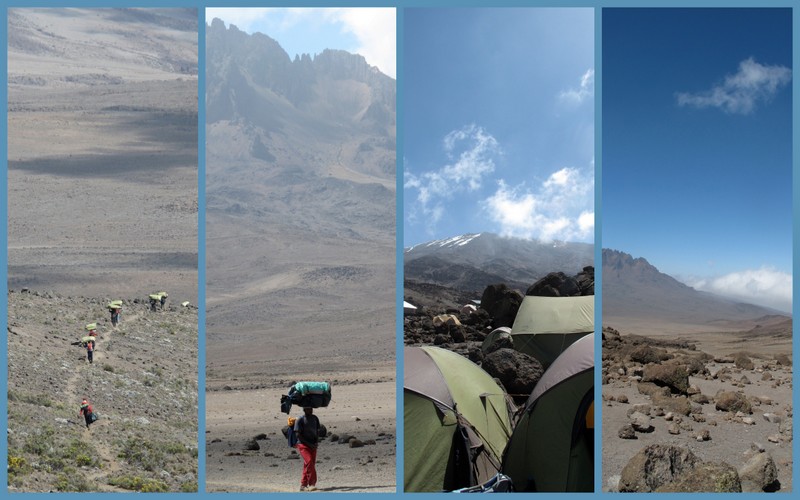
Today's walk is mostly on the flat. The summit crater, Kibo, dominates the view now. Somehow, it's been hard to comprehend we're on a mountain up to this point – it's just so large. But this cone-shaped peak looks just like the classic idea of a mountain. And a steep one at that. As we walk closer to it, a narrow grey seam straight up the side becomes visible. That's our path for later on that evening. It seems best not to think about it too much.
The mood is buoyant, and several of the group members seem to be enjoying a rush of energy as they power across the open expanse. The backdrop of Kibo is perfect photo material, and halfway across we stop for group pictures, full of smiles. The Lunar Desert is exposed and windswept but the weather is obliging us with sun and no clouds. When we stop for a break, we're like lizards basking on the rocks. We share snacks. I've brought crystallised ginger, which, along with ginger tea, is a miracle cure for nausea. Hovering on the edge of sickness the whole time, it's nice to know there's something that will help alleviate it.
By lunchtime, we arrive at Kibo Camp, our base for attempting the summit. It's where the Marangu and Rongai routes meet. There are permanent huts here, rats (although I didn't see them), a lot of dust, and another signing-in point. All the way up the mountain we've had to sign in at each camp, adding our names, ages, nationalities and professions to the others already in the books. The camp is busier than expected, so our tents have been pitched at a lower level near a rocky outcrop below the permanent camp. It's probably barely 100 metres further down but in the thin air this seems like an extra mile. We have a great view of Mawenzi, though. One of my fellow trekkers is particularly happy at this: it's become a bit of an in-joke that although we're climbing Kibo, all she's going to have is photos of Mawenzi, from all angles, all times of day and night...
As well as the standard soup for lunch (to up our fluid intake), we're now on to the tinned food. Afterwards there's time for rest, for repacking of our day packs to minimise the weight for the final climb, and, for three of us, more card games. Dinner is at 5.30pm, and suddenly the summit climb seems scarily real. Our guides give us motivational speeches: that we're a strong group, that we can make it to the top. There's another Exodus group climbing the same route as us – we'd first met them at the airport – but I think we're feeling slightly smug that we've been walking faster than them the whole way. Hopefully pride won't come before a fall. We're already a guide down after one had to leave to get medical help for an unexplained swollen hand. A porter is going to step up to his place instead, in fact the porter who has had the crummy job of looking after the toilet the whole way up the mountain. We're saving a large tip for him.
It's straight to the tents for some kip after dinner. I'm sharing with two other women, and we're feeling a bit hyperactive – laughing away for a good half an hour. Apologies to anyone we kept awake. But I sleep eventually, and when the guides wake us up at 11pm (yes, that's 11pm) ready for breakfast and our attempt on the summit, I feel pretty positive and excited. It's time to head for the heights.
This is my fourth post about my trip-of-a-lifetime climbing Mount Kilimanjaro and going on safari in Tanzania. I'm raising money for Water Aid so if you would like to sponsor me, please click here.
Wednesday, 31 July 2013
Gromits Unleashed
One of the city's most famous residents, Gromit has been the inspiration for a Bristol-wide art project. There are 80 model Gromits around the city, inside and outside buildings. There's even one as far afield as Paddington station. Presumably the Bristol-born dog is making friends with the famous bear from Peru. The Gromit artists include a host of local and international names, with well-known faces including Quentin Blake, Cath Kidston and Raymond Briggs. The whole project is raising money for Wallace and Gromit's Grand Appeal, the Bristol Children's Hospital Charity. Here are a few of the Gromits I've snapped on camera recently.
Monday, 15 July 2013
Above the clouds
Day 3 Thursday 20 June 2013
The ravens - those ominous black birds with beaks that look like they could rip flesh from bone - have been wandering near the tents, scavenging for food. There are more flying low to the ground, calling. From inside the tent, they sound uncomfortably close.
Once I open the tent flaps and step outside, I can see it is a beautiful day. The mists of the previous night have passed, and both the peaks of Mawenzi and Kibo are clearly visible. I turn round, and, truly, the view is breathtaking. We are above the clouds. The white billows roll into the distance. It is the sort of scene I've only seen from a plane window before, a snapshot in a small frame. But here we are, as high as an aeroplane, taking in this panorama. Except we've taken the tough option to this other world: one foot after the other.
With the sun out, the air not too cold, I decide this might be a good time to try to wash my hair. I have washed my fringe on the other days, test runs. After this camp, I think we might be too high, too cold for such luxuries as hair washing. So, I give it a go. Sit down, dip head in bowl and splash water all over. Rub in shampoo, and try not to flick it everywhere. That was the easy bit. Now for the rinsing. Our guide takes pity on me and offers to pour the water over my head. It works a treat. Travel towel turban in place, breakfast time!
Have I described our breakfasts? There is the sloppiest porridge you have ever seen, though it tastes better than it looks. Toast, peanut butter. Fruit, eggs, sometimes bacon. The eggs are different from those back in the UK – the yolks are white. Perhaps the hens are fed differently out here.
After the long walk yesterday, today's is shorter. But steeper. And in the heat it feels like a slog. Every few minutes the cry of 'porters' goes up, sometimes with an indication of direction, although as a group we don't seem that good at grasping whether to 'stay left' or if the porters are 'on the left'. The other left, that is.
At our first stop, a few of us need the loo. By now the landscape has changed enough that this is a bit of problem. No trees, no large bushes. Not even any small shrubs. There is a possible looking rock not too far from the path, and, on closer inspection, the litter of tissues behind it suggests others have been here before. It is a bit disconcerting, being within sight of the resting groups. Particularly when one of them includes the rugby players. But everyone seems to have mastered the art of tactfully looking the other way.
Our second stop is after another climb, at a rocky plateau. I feel overwhelmed by tiredness and lie back on my pack on a rock. The others climb up high on to a big rock with a view. The rugby lads are clearly enjoying themselves, and decide it is time for a kickabout, seeing who can get the ball the furthest. Their official photographer takes much better pictures of this than I do. I haven't seen them, but as you can see, mine are pretty bad so I can safely say his will be better.
We continue. By now I am not feeling great and, disconcertingly, my balance has gone AWOL. As we meander into Tarn Camp (c.4,330m), just below Mawenzi, all I want to do is sit. So, this is my first brush with altitude sickness. There's time to rest before lunch, so I lie down in the tent. It's boiling hot inside and it feels like the sun is burning through the roof. My head hurts. Sitting down for lunch in the mess tent an hour later, I feel dizzy and like I can't breathe properly. I try to eat but my appetite has gone. I feel ready to cry. That's not quite true. I'm afraid I do have a cry. Everyone is supportive and sympathetic, someone brings Nurofen. and it turns out that quite a few of us are starting to suffer from altitude sickness: headaches, nausea, loss of appetite. Reassuring, although obviously it'd be nicer if no one was feeling it.
Our acclimatisation walk that afternoon takes us up the peak behind the tarn lake, a stagnant looking pool with green algaed edges. It's a bit of a scramble up the steep path, but there are good views at the top. And back down at camp, breathing already feels easier. That night most people go to bed early, with several members of the group feeling pretty ill. I stay up – by this I mean something in the region of 8pm – and play Uno with a couple of others. I'm going to blame my staggeringly bad play on the altitude sickness.
That night I feel much better although it's difficult to breathe. We've been told to leave the vents on the tent open and to sleep with our heads higher than our feet to help. Up til this point I've been enjoying the trip, but, now it's difficult to breathe and my chest feels tight. I start to wonder what on earth I am doing up here. Is this just going to get worse? Is it wise to spend time at the top of a mountain where there's only half the oxygen you need? Why am I only considering this now, more than halfway up a stupidly high mountain? I wouldn't say it was a full-blown panic, perhaps a mild midnight existential crisis. The sort that, hopefully, has faded into your dreams by the morning.
This is my third post about my trip-of-a-lifetime climbing Mount Kilimanjaro and going on safari in Tanzania. I'm raising money for Water Aid so if you would like to sponsor me, please click here:
Tuesday, 2 July 2013
The goal is in sight
(c) Rebecca Franks
Day 2 Wednesday 19 June 2013
Starts are early on the trek. (Well, early for an arts journalist.) At 6.30am there's a call outside the tent to wake-up. And then a real luxury: we are brought a hot drink. I have tea, with sugar. I've decided sugar is acceptable while hiking. It was also my excuse for eating whatever I wanted the whole week before I came to Africa. Fuelling up.
Outside the tent there's a surprise. The mountain! Above the treeline rises the summit, looking remarkably friendly. Another of the golden rules is to smile at the mountain. It might sound a bit hokum-pokum, but I also feel like it might make sense. When I used to sail, I felt you had to have respect for the sea. But you had to remain positive too, and enjoy it. The same must be true for mountains, potentially dangerous places. Respect, and affection.
Another surprise awaits. One of the two other groups trekking the same route as us includes four rugby players from South Africa, including the legendary Percy Montgomery. I say this like I know who that is, but to be frank I don't have a clue. I have, since getting home, googled them and am pretty impressed. What I did know then, however, was that when we all sauntered into their bit of the campsite to get a better look at the mountain, the four strapping men said hi to all of the women in our group, but none of the men. Definitely charmers.
Today is a long walk, seven or eight hours depending on how we go. It's hot and humid, even when it starts to cloud over later on. Single file is pretty much order of the morning, regularly stepping to one side to let the porters hurry past at least twice the speed we're going. I still can't understand how they can balance those huge bags on their heads. I'm getting used to the view of the feet of the person in front. Even at a slow speed lots of concentration is required not to trip over the pebbles and rocks.
As we walk, the group start to get to know each other. Ages: 18 to 50s. Nationalities: mostly UK, also Canadian and Australian. Jobs: we've got a lawyer, banker, vet, insolvency practitioner, student, journalist, accountant, IT consultant, sales person, policy worker, buyer and engineer. A pretty good range. No doctor, but it turns out the vet has enough medication to tend to us all up and down the mountain ten times if needs be. People are here for a variety of reasons: charity fundraising, personal challenge, and – it has to be said – there seem to be a fair number of 'I split up with/was dumped by my girl/boyfriend' comments thrown in there. Nothing like heartbreak to inspire you to do crazy things, right?
We also start to get to know our guides, all Tanzanian. They've all been porters, sometimes for up to five years, beforehand, and all hope to be chief guides. They all speak English, one also speaks French. English and French are the most popular second languages, he explains. German and Italian are much rarer, and although people do want to learn them it's often too expensive to. One guide, who goes by the name of Tony Blair, was on the Comic Relief trek up Kili a few years ago. 'Alesha is my friend, she's fantastic,' (I paraphrase), 'always singing, always smiling.' Chris Moyles was his buddy, as was Gary Barlow, he says. Cheryl Cole, meanwhile, had to bring a bodyguard and three men to make sure no paparazzi were hiding in the bushes, snapping her climbing or taking a loo break. Fame, TB and I agree, must be a horrible thing. At the same time, I'm reminded of my motto: 'If Cheryl Cole can do it, so can I.' Not quite sure how I've made this logic jump, but somehow the thought is helpful.
We stop at a cave before lunch. Porters used to sleep here, we're told, but now they have tents. Throughout the trek, it seems clear that while the guides might be well paid (that's a guess rather than a given), the porters aren't. The park regulations stipulate $10 per day, so about £6.60, but that's not a legal requirement and not all the porters make even that measly amount. And they are often poorly kitted out for the job. In 2002, three guides died of hypothermia after a storm on the mountain and it seems that several still die each year, though figures are hard to come by. We all resolve to leave behind clothes for them and give generous tips. It's not much. It's horrible to realise that, despite all the benefits of tourism to a poor country like Tanzania, there is a long way to go in ensuring the wealth reaches more than a chosen few. And, however much I know that I couldn't carry up all I need to reach the top, it never feels comfortable to see other people doing it for you.
The landscape is different after lunch. We've left behind the gentle greens of the trees and their hanging moss, and seem to have entered an alien, grey, dusty world. As we reach our camp in a valley near Kikelewa Caves, huge black birds lurk on rocks and fly overhead. Their beaks look lethal. And the air is noticeably cooler. We're now at around 3,600m. We hop over a small stream and scramble up into our camp. Two of the three peaks of Kilimanjaro are visible: Mawenzi, all craggy and moody; and Kibo, the highest, which we'll be heading up in a couple of days time. We're all still feeling chirpy.
Our evening ends in the mess tent with games of cards. Rummy has been usurped by Uno (the special deck includes wild cards; the aim is to get rid of all your cards), and unbelievable amounts of cheating. I haven't played Uno for years, and, as I lose game after game, I am starting to remember why. Although I am doing marginally better than the person who has to pick up 18 cards in what must be an Uno record.
I am raising money for Water Aid, and you can still sponsor me here: http://www.justgiving.com/Rebecca-Franks1
Monday, 1 July 2013
Kilimanjaro: pole, pole
(c) Rebecca Franks
Over the next few days I'm going to be blogging about my trip-of-a-lifetime climbing Mount Kilimanjaro and going on safari in Tanzania. I'm raising money for Water Aid so if you would like to sponsor me, please click here:
Terminal 4, Heathrow Airport on a Sunday evening. It's a busy place to be. I'm trying to spot my fellow travellers, but there are too many likely-looking people in the Kenya Airways queue: there are enough daypacks and big kit bags to set up shop. Climbing Kilimanjaro is clearly a popular activity. I've also made my first rookie error: taking my malaria tablet without food. Nausea isn't the best start to the trip.
After eight hours in the skies, I arrive in Nairobi, Kenya, a short plane skip away from Kilimanjaro, and by chance meet up with someone else in my Exodus group. Even in the early morning, Nairobi airport is heaving with travellers from all over the world: two Indian men tell us they are heading to East Africa where they have mining interests. There seems to be a constant flow of Japanese soldiers wandering past our gate. And there's a large group of American teenagers who, it's clear from their loud T-shirts and chatter, are on their first trip to Africa for missionary work.
The sun is bright as we fly into Tanzania, high above the clouds. And then suddenly there it is: Mount Kilimanjaro. The 5,895m peak rises proud out of the whiteness, both beautiful and daunting. The Kenyan businessman I'm sitting next to is baffled. 'So you just woke up one day and decided, right, I'll go and climb Africa's highest mountain?'
Yup. It's strange, but that's pretty much what happened in January this year. With three months off work on sabbatical, I wanted to do something out of my comfort zone and unforgettable.
I'll fast forward through meeting the other 11 members of my group, the bus ride to the hotel, drinking a Kilimanjaro beer, organising the bags ready for the next day and the briefing which I'm ashamed to say in my sleep-deprived state I kept nodding off during, and cut now to the first day of trekking.
Day 1 Tuesday 18 June 2013
It's a twoish-hour drive to the bottom of the Rongai Route, one of the six possible ways up the mountain. The Marangu or 'coca-cola' route is the shortest, with huts to stay in the whole way up. The Rongai - or Nalemuru as it's labelled though never called – is the only route to approach the summit crater from the north. On the Lemosho Route, one of the group gleefully tells us, you travel with an armed guard through the rainforest to ward off the wildlife.
After meeting our guides from the African Walking Company – more of which later – and signing in to the National Park, we start our walk at a glacial pace: 'pole, pole', meaning 'slowly, slowly', is one of the golden rules of the mountain. (Confusingly, pole, pole means slowly, a single pole means sorry.) Along with drinking at least four litres of water a day, ascending slowly is meant to help avoid altitude sickness. The first day is a short four-hour walk through forest, passing a bright array of stalls selling drinks, and with the porters rushing by us, bags often balanced on their heads. At lunchtime we're impatient to get going, eager to take on the mountain. We still haven't seen the summit yet. Frustratingly, it even stays behind the mist and clouds on our short acclimatisation walk – this is when you go above the the height at which you will sleep to stimulate your body to produce more red blood cells so you can carry more oxygen.
Our first camp is small, muddy, surrounded by shrubs and bushes. The blue toilet tent is tucked away. One member of our group decides to give it a go. Unbeknown to him, the porter with the unenviable task of looking after the loo – a portable plastic one – gathers the rest of the group round for a demo of how to flush it. When our unsuspecting toilet-goer emerges, he's taken aback to be greeted by 12 expectant faces.
We're also introduced to the concept of 'washy washy'. Every day, morning and late afternoon, we're given a bowl of hot water to wash in. For me it becomes something to look forward to, washing away the dust and dirt, scrubbing grimy fingernails and bathing weary feet. And our first cooked meal that evening is a revelation: a three-course affair with soup, a main course and fruit for desert, and lots of hot water and tea. The cook, or stomach engineer as he's known, clearly knows what he's doing. We all head to bed at an early hour in good spirits.
Subscribe to:
Posts (Atom)